rail
Great British Railways strategy drops leasing as default for new train fleets
Transport Secretary Heidi Alexander has notified Parliament of a Great British Railways strategy that will weigh direct ownership against leasing for each new fleet and standardise trains around fewer fleet families.
Transport Secretary Heidi Alexander has told MPs that Great British Railways (GBR) will weigh direct ownership against leasing for every new train fleet, under a rolling stock and infrastructure strategy published on 28 September 2026.
In a written statement to the House of Commons on 12 October, Alexander said the Department for Transport (DfT) and DfT Operator Limited, the government's rail owning group, had published the document jointly during conference recess, so she was notifying the House at the first opportunity.
The strategy sets a long-term framework for how GBR will plan and deliver rolling stock and the infrastructure that supports it, the statement said. GBR will assess direct ownership, leasing and other financing arrangements case by case rather than rely on a single default model.
The Railway Industry Association (RIA), which responded to the strategy on 29 September, welcomed the direction but said the document is not yet a funded delivery plan. Darren Caplan, Chief Executive of the Railway Industry Association, said: "We particularly welcome the prospect of a clearer, longer-term pipeline."
Fleet families and financing
The DfT said future train procurements will be structured around a smaller number of nationally defined fleet families, giving more consistent compatibility and capability across the network while retaining flexibility for different markets and communities.
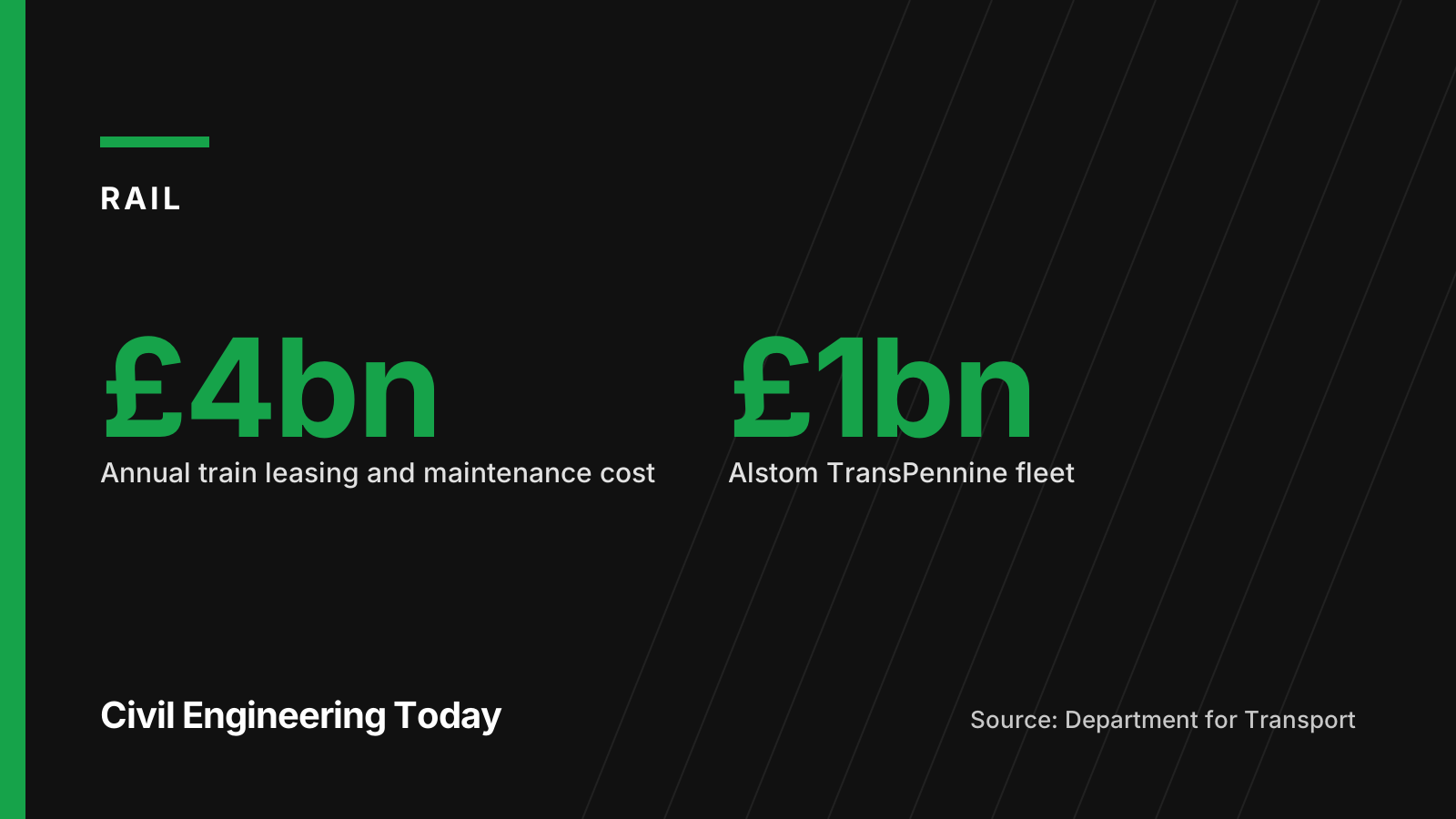
The government's press release on 28 September said leasing and maintenance of trains cost taxpayers and passengers more than £4bn a year, and cited Office of Rail and Road figures showing dividends from rolling stock companies totalled more than £2.5bn over the last 10 years. New trains could be publicly owned rather than leased under the plans, it said.
The strategy also sets expectations for accessibility, including level boarding and alighting where possible, accessible toilets, consistent passenger information and reliable wifi, according to the statement.
On decarbonisation, GBR will progressively replace diesel trains with cleaner technologies, the DfT said, using electrification, battery-electric trains and other solutions, with decisions taken on a whole-life and whole-system value basis.
The planning tool suppliers are waiting for
The strategy will be underpinned by a fleet and infrastructure plan (FIP). The DfT said the FIP will remain an internal planning tool but will support sharing appropriate information with the market on forthcoming fleet and infrastructure requirements.
For UK manufacturers and suppliers, the government said fewer unnecessary fleet variations and clearer future requirements will give a stronger basis to invest, retain skills, plan capacity and compete for work.
RIA said the FIP will be critical in giving businesses the detail they need, including indicative volumes, timescales, electrification priorities, procurement opportunities and funding status. Caplan said freight was notably absent from the strategy and that the FIP must support the government target to grow rail freight by 75% by 2050. "The FIP is therefore urgent," he said.
The Alstom precursor
The government linked the strategy to its 11 September announcement of a £1bn investment in 29 British-built battery-electric trains for TransPennine Express, to be built at Alstom's Litchurch Lane Works in Derby from 2028. The DfT said the deal would support more than 350 highly skilled jobs in Derby and a further 6,000 across the UK supply chain, with the trains entering service from winter 2034.
That fleet, however, follows the leasing route the strategy no longer treats as the default: the DfT said the trains will be bought by Rock Rail and leased to TransPennine Express. Hull and East Yorkshire Combined Authority said financing comes from Rock Rail's Next Generation Rail Fund, co-managed with Aberdeen Investments, and that the order is for 29 five-carriage Alstom Adessia Stream trains.
The combined authority said new charging points are planned at Hull, Scarborough and Saltburn to support the battery fleet across the full TransPennine Express network.
What happens next
GBR is intended to be the single directing mind for the railway, bringing track and train together and operating most passenger services under public ownership, according to DfT guidance. The Railways Bill, introduced in the Commons on 5 November 2025, is still being scrutinised in the House of Lords, and GBR is expected to be operational about 12 months after Royal Assent.
Six operators' services have so far transferred to public ownership, from South Western Railway on 25 May 2025 to Chiltern Railways on 20 September 2026. Great Western Railway is next on 13 December 2026, followed by Avanti West Coast on 7 March 2027, with all DfT-contracted services expected to be in public ownership by the end of 2027.
On the record: Department for Transport
Sources
- Department for Transport (GOV.UK) (opens in a new tab) (accessed 2026-10-12)
- DfT Operator Limited and Department for Transport (GOV.UK) (opens in a new tab) (accessed 2026-10-12)
- Department for Transport and DfT Operator Limited (GOV.UK) (opens in a new tab) (accessed 2026-10-12)
- Department for Transport (GOV.UK) (opens in a new tab) (accessed 2026-10-12)
- Department for Transport (GOV.UK) (opens in a new tab) (accessed 2026-10-12)
- Hull and East Yorkshire Combined Authority (opens in a new tab) (accessed 2026-10-12)
- Railway Industry Association (opens in a new tab) (accessed 2026-10-12)
This story was researched from the primary sources above and checked against them before publication. Spotted an error? Tell us and we will correct it promptly.