energy
Minister points Celtic Sea floating wind developers to SSEP consultation in early 2027
Energy minister Michael Shanks has told the Celtic Sea Developer Alliance that a draft Strategic Spatial Energy Plan should go to consultation in early 2027, after the group pressed for a long-term pathway for floating wind.
Energy minister Michael Shanks has told floating offshore wind developers in the Celtic Sea that a draft of the first Strategic Spatial Energy Plan (SSEP) is expected to go to consultation in early 2027, once the government has chosen a pathway.
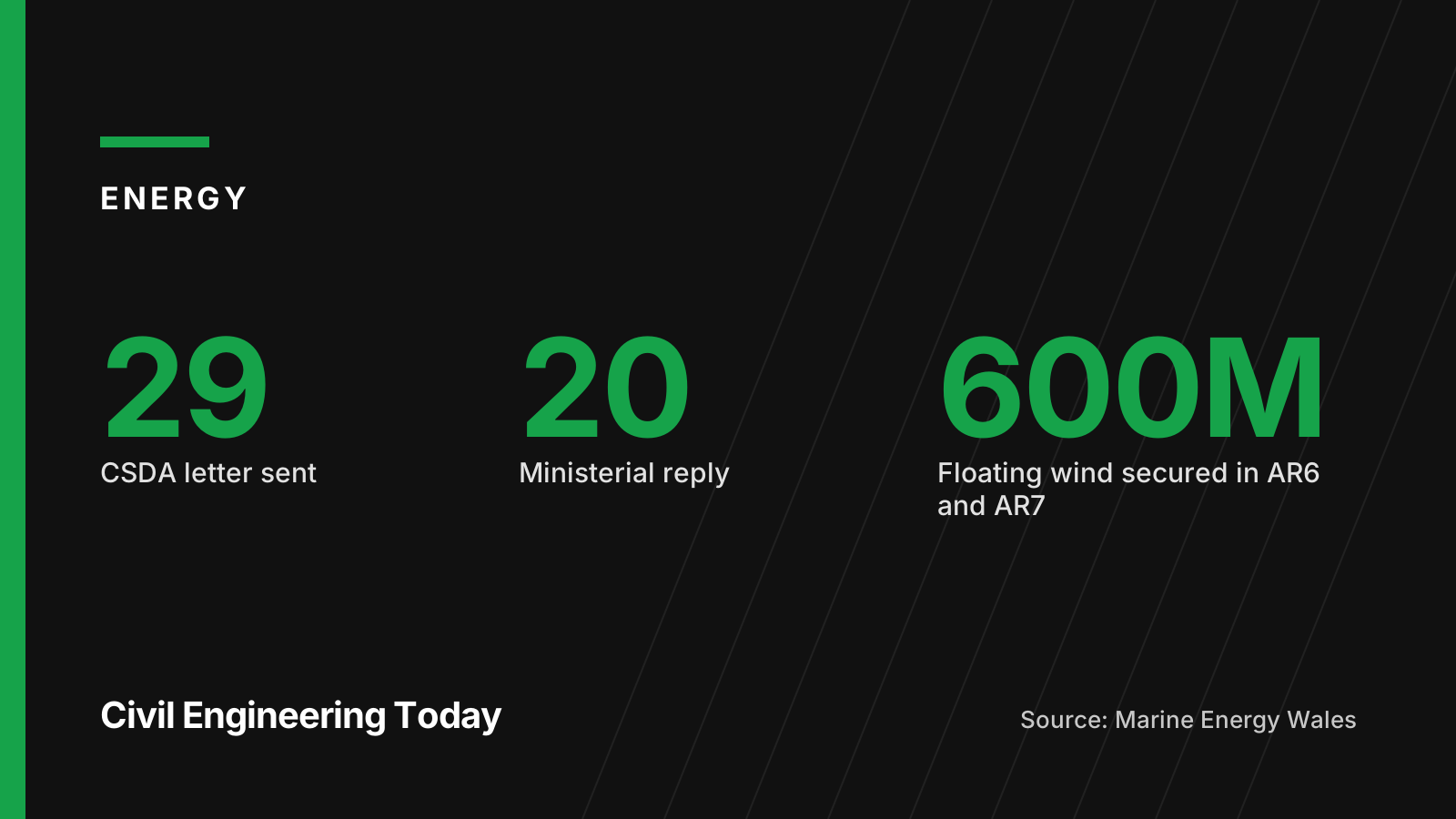
The reply, dated 20 October, answered a letter sent on 29 September by the Celtic Sea Developer Alliance (CSDA) to Miatta Fahnbulleh MP, Secretary of State for Energy Security and Net Zero, according to Marine Energy Wales, which chairs the alliance and published details of the exchange.
The CSDA letter, written by former chair Tom Hill, urged the government to select an SSEP pathway that gives the region "the confidence and opportunity to move from today's first projects to a sustained commercial market."
Mr Shanks, Minister of State for Energy, said in response that a "range of real-world trade-offs" must be considered as the plan is developed, Marine Energy Wales reported.
The minister's response
According to Marine Energy Wales, the minister said nearly 600MW of new floating offshore wind capacity had been secured through Contracts for Difference (CfD) Allocation Rounds 6 and 7, including the first capacity in the Welsh Celtic Sea. He said delivering those projects would provide learning to support cost reduction ahead of commercial-scale deployment.
The response also referred to port infrastructure, and said the government has committed support for planned investment at Port Talbot.
On the SSEP, Mr Shanks said the government is considering the pathway options it received from the National Energy System Operator (NESO) alongside its own analysis. Marine Energy Wales said he gave assurances that the Secretary of State will consider impacts on wider economic growth and reindustrialisation, as well as on energy bills, alongside NESO's assessment of costs, network and environmental impacts.
The Department for Energy Security and Net Zero said separately that Allocation Round 7 secured a record 8.4GW of offshore wind in total.
The CSDA's case
Marine Energy Wales said the letter set out three priorities: a long-term pathway for the Celtic Sea that keeps enough visibility and optionality in the SSEP to give The Crown Estate confidence to run further leasing rounds; recognition of the potential for cost reduction in floating and deep-water wind, so that pathway selection does not embed a first-of-a-kind disadvantage; and alignment between energy planning, network investment, leasing, revenue support and industrial policy.
The letter cited the Celtic Sea Blueprint, a report commissioned by The Crown Estate, which estimated that capital expenditure on the 4.5GW Celtic Sea programme could deliver £1.4bn in gross value added. Marine Energy Wales described the Blueprint's jobs estimate as an average of 5,300 jobs over five years; The Crown Estate's own release on the study, dated 22 February 2024, put it at up to 5,300 new jobs and up to £1.4bn for the UK economy.
The Crown Estate said the study, conducted by Lumen Energy & Environment, identified gaps in the supply chain including ports deep enough to handle the turbines. Its Round 5 leasing sites lie off the coasts of South Wales and South West England, with each project development area able to host up to 1.5GW, and the first three floating wind farms able to generate up to 4.5GW in total, according to The Crown Estate.
The SSEP timetable
NESO said it submitted its SSEP Pathway Options Report to the UK, Scottish and Welsh governments on 28 August. The report sets out six pathways that NESO described as its independent view of potential energy system futures. The UK Energy Secretary decides which pathway to take forward, with the Scottish and Welsh governments in a formal advisory role, NESO said.
The SSEP will be the first overall plan for Great Britain's energy production and storage from 2030 to 2050, according to NESO.
NESO said on 5 December 2025 that it and DESNZ had decided to re-run the SSEP modelling using the latest data, pushing the timetable back. Public consultation on the draft is due in early 2027, with the final SSEP now expected in autumn 2027.
On the record: Department for Energy Security and Net Zero, The Crown Estate
Sources
- Marine Energy Wales (opens in a new tab) (accessed 2026-11-14)
- The Crown Estate (opens in a new tab) (accessed 2026-11-14)
- The Crown Estate (opens in a new tab) (accessed 2026-11-14)
- National Energy System Operator (NESO) (opens in a new tab) (accessed 2026-11-14)
- National Energy System Operator (NESO) (opens in a new tab) (accessed 2026-11-14)
- Department for Energy Security and Net Zero (GOV.UK) (opens in a new tab) (accessed 2026-11-14)
This story was researched from the primary sources above and checked against them before publication. Spotted an error? Tell us and we will correct it promptly.