contract awards
CECA members discuss CCBP call to mandate early contractor involvement on public projects over £5m
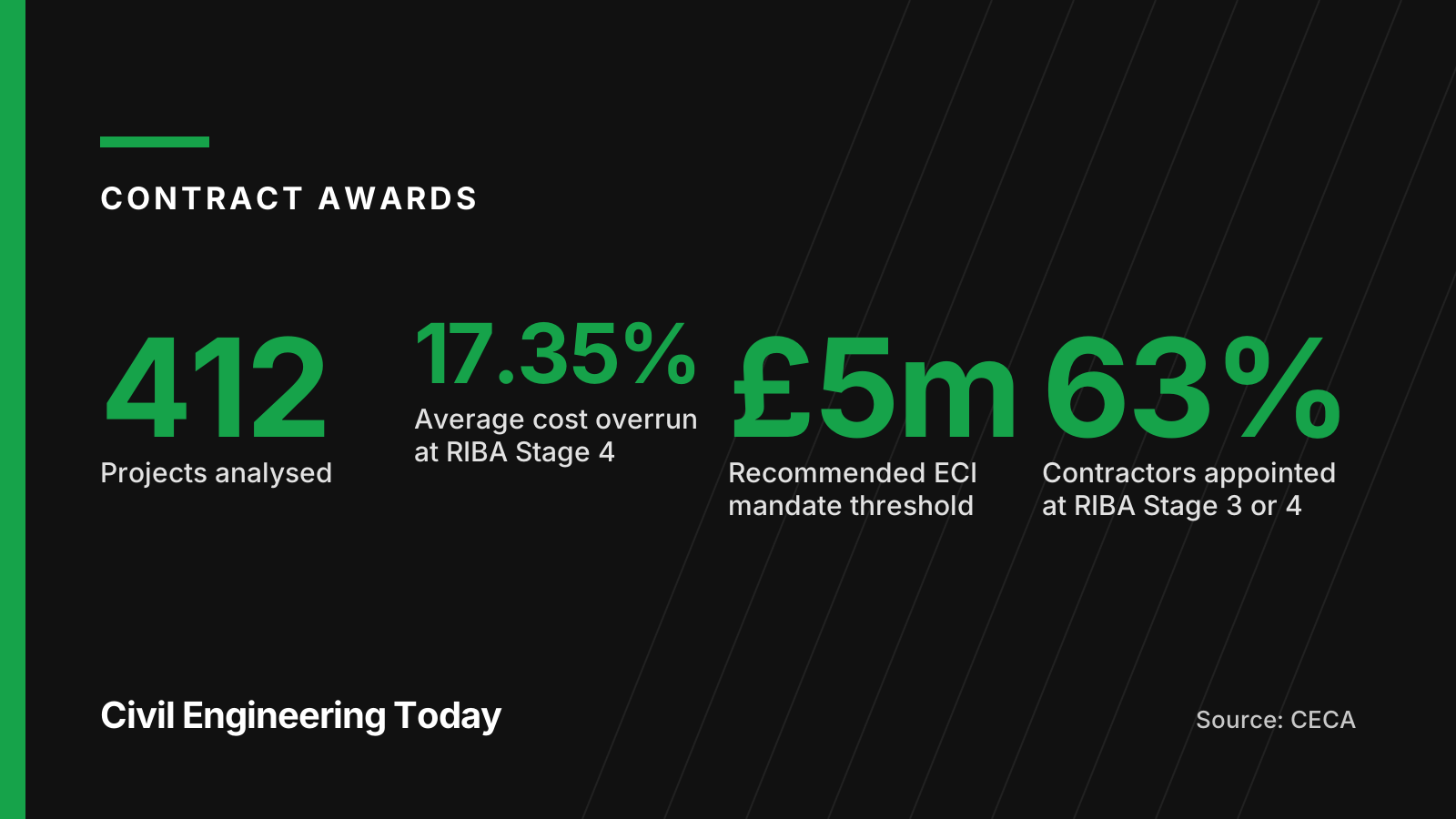
Civil engineering contractors have discussed Centre for Construction Best Practice research into 412 public-sector projects, which links late contractor appointment to cost overruns of up to 17.35%, and its three recommendations for government.
Members of the Civil Engineering Contractors Association (CECA) have discussed research from the Centre for Construction Best Practice (CCBP) that calls for contracted early contractor involvement to be mandated on public-sector capital projects worth more than £5m.
The online roundtable, reported in a blog by Ben Goodwin, CECA's Director of Policy and Public Affairs, examined CCBP's Constructing Certainty study, which analysed 412 UK public-sector projects delivered by 55 contractors to test how the timing of contractor appointment affected outcomes.
CECA said the research found that the later contractors are brought in, the more likely cost and programme overruns become. It noted the study mainly covered the social and commercial sectors of the built environment, but said the findings and recommendations were also relevant to economic infrastructure.
CECA said the recommendations have been backed by Mike Reader MP. Reader, Labour MP for Northampton South, who CCBP describes as Chair of the APPG for Excellence in the Built Environment and whom CECA's blog describes as chair of the All-Party Parliamentary Group on Infrastructure, said: "Too often, our procurement system is designed to manage risk through process rather than reduce it through collaboration."
The figures
CCBP describes Constructing Certainty as a Government-backed industry whitepaper. According to its published findings, cost performance stayed broadly stable where contractors were involved before RIBA Stage 3, and projects where the contractor was appointed at RIBA Stage 0 came in 1.79% under budget on average.
Where contractors were appointed at RIBA Stage 3, CCBP found an average cost overrun of 8.56%, rising to 17.35% at Stage 4. On programme, later appointment was associated with an 11.53% increase in duration at RIBA 3 and 12.84% at RIBA 4.
| Contractor appointed at | Average cost variance |
|---|---|
| RIBA Stage 0 | -1.79% |
| RIBA Stage 3 | +8.56% |
| RIBA Stage 4 | +17.35% |
CCBP said 63% of public-sector contractors are still appointed at RIBA Stage 3 or 4, after key design decisions have been locked in. It also reported that 96% of 412 industry respondents supported earlier contractor involvement, while only 6% strongly agreed that current procurement routes deliver it.
Across the 10-year UK infrastructure pipeline, CCBP gave an indicative saving of £11.7bn if contractors were appointed at RIBA 2, against an indicative overrun of £125bn if they were appointed at RIBA 4.
The recommendations
CCBP's first recommendation is early contracted involvement by RIBA Stage 2, applied as the default on public-sector capital projects above £5m and proportionate to risk and complexity. It said refurbishment and renewal should be the first area where the standard is applied.
Its second recommendation is to strengthen public-sector capability and confidence in early contractor involvement (ECI). The third is mandatory value checks at award, so that contracts are not let on lowest price alone and the incentive for price-to-win behaviour is reduced.
CCBP's Industry Advisory Group is made up of senior representatives from BAM, Kier, Morgan Sindall and Wates. Wates said in July 2025 that the research had been launched with support from Government, other Tier One contractors and five academic institutions, following a roundtable with main contractors including Wates, BAM, Kier, Morgan Sindall and Stepnell. In June 2026 Wates said the whitepaper had recently been launched and uses real-world public sector project data to test whether ECI improves delivery at scale.
Pat Fitzgerald, Group Commercial Director at Wates Group, said: "ECI brings greater certainty to all parties".
The civils view
CECA said roundtable participants reinforced that the recommendations had practical relevance to economic infrastructure networks, and pointed out that many of the 412 projects studied had civils contracts attached to them.
Discussion also covered the need to strengthen compliance with the Construction Playbook's position on ECI, and the case for extending the Playbook's reach beyond central government procurement. The Cabinet Office published the Playbook on 8 December 2020 and last updated it on 11 July 2023; it sets out 14 key policies that central government departments and their arm's length bodies are expected to follow on a comply or explain basis.
Participants also considered how ECI could do more to drive the environmental sustainability of infrastructure projects by embedding approaches and standards such as PAS 2080 across delivery cycles, CECA said.
CECA has more than 300 members, who it says carry out an estimated 70-80 per cent of all civil engineering activity in the UK.
What happens next
CECA said CCBP continues to advocate for the adoption of its recommendations.
CECA's next online policy session will be held with the National Infrastructure and Service Transformation Authority (NISTA) on 9 December, to workshop the next iteration of the Infrastructure Pipeline. The government launched the pipeline on 17 July 2025 with around 780 public and privately led projects, outlining £530bn of projects and programmes over ten years, including £285bn funded solely by the public sector. NISTA manages the pipeline and updates it on a regular basis.
On the record: Kier
Sources
- Civil Engineering Contractors Association (CECA) (opens in a new tab) (accessed 2026-10-28)
- Centre for Construction Best Practice (CCBP) (opens in a new tab) (accessed 2026-10-28)
- Civil Engineering Contractors Association (CECA) (opens in a new tab) (accessed 2026-10-28)
- Wates Group (opens in a new tab) (accessed 2026-10-28)
- Wates Group (opens in a new tab) (accessed 2026-10-28)
- HM Treasury / NISTA (GOV.UK) (opens in a new tab) (accessed 2026-10-28)
- Cabinet Office (GOV.UK) (opens in a new tab) (accessed 2026-10-28)
This story was researched from the primary sources above and checked against them before publication. Spotted an error? Tell us and we will correct it promptly.