roads
DfI launches Mercury review of Northern Ireland roads operating model and workforce
The Department for Infrastructure has screened its new Mercury TRAM Transformation Programme, a review of how the group maintaining Northern Ireland's roads operates, and found no full equality impact assessment is needed.
The Department for Infrastructure (DfI) in Northern Ireland has begun a review of how its Transport and Road Asset Management (TRAM) Group operates, publishing an equality screening of its new Mercury Programme on 25 November 2026.
The Department describes the Mercury Programme as a comprehensive and forward-looking review of the TRAM Group's operating model. It said the programme is designed to ensure the organisation remains resilient and sustainable in a rapidly changing environment.
According to the Department, the programme responds to significant operational challenges, sustained financial constraints and ever increasing workforce pressures. It incorporates the TRAM Group Workforce Strategy.
The screening notice classifies the programme as a new policy rather than a revision of an existing one. The screening was carried out on 25 November 2026 and the recorded outcome was that a full Equality Impact Assessment (EQIA) is not recommended.
The screening process
Section 75 screening is the step by which the Department tests new and existing policies for their equality implications. Under its Equality Scheme, the Department commits to consult on the creation of new policy and the implementation of existing policy.
The Department has also undertaken to consult on policies that are subject to equality screening and then screened out, and it publishes screened policies on a quarterly basis. The full screening document for the Mercury Programme is a 1.3MB PDF published alongside the notice.
The TRAM Group
The Department says the role of the TRAM Group is to maintain, manage and develop the transport network, which it says underpins many strategic Government objectives. The group's business areas include Transport Policy and Planning, Major Projects, A5 and Active Travel, Road Asset Development, Road Asset Maintenance and Road Engineering.
Colin Sykes leads the group. The Department's About DfI TRAM page describes him as Deputy Secretary, while its register of senior civil servants, formally reviewed in July 2026, lists him as Acting Deputy Secretary for Transport and Road Asset Management. The Department says he is responsible for the DfI Asset Management Strategy, Road Asset Maintenance and Road Asset Development Schemes including Active Travel and EV Infrastructure.
Mark McPeak, Director of Road Asset Maintenance, is responsible for routine and structural maintenance, DBFO contracts, public liability claims and emergency response including winter service. Jonathan Saulters, Director of Major Projects, is senior responsible owner for a number of major roads schemes.
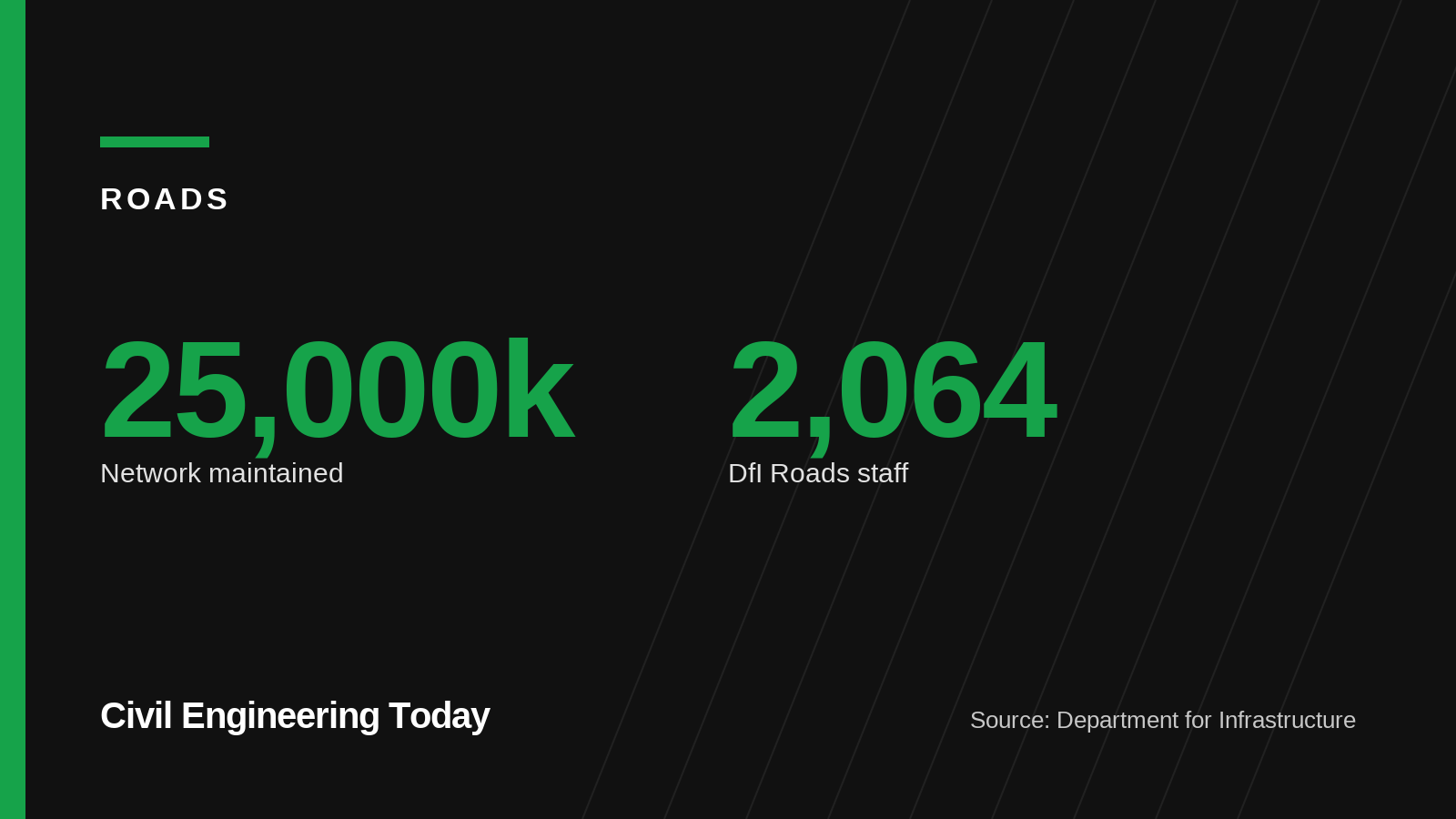
According to the Department's DfI Roads overview, the organisation maintains over 25,000km of public roads, about 9,700km of footways, 5,800 bridges, 290,000 street lights and 367 public car parks. A December 2025 ministerial release put the road length at over 25,922km and valued the network asset at about £36bn.
DfI Roads employs 2,064 people across offices and local depots in Northern Ireland, with its headquarters in Belfast and four divisional offices in Belfast, Coleraine, Craigavon and Omagh.
The maintenance strategy
The Mercury review follows a change of direction on road maintenance set out last year. The Department published a draft Road Maintenance Strategy for consultation on 2 December 2025, with Infrastructure Minister Liz Kimmins outlining a new approach focused on greater use of technology.
Kimmins said at the time: "It has become apparent over recent years of the necessity to develop a new approach".
She added: "We will be targeting our resources where they are needed most and using new technology", citing digital surveys to assess road conditions.
The Department has not published detail in the screening notice of the programme's workstreams, headcount changes or timetable. Under its Equality Scheme, the screened-out policy will be included in the Department's quarterly list of screened policies and is subject to its consultation commitments.
Sources
- Department for Infrastructure (Northern Ireland) (opens in a new tab) (accessed 2026-11-26)
- Department for Infrastructure (Northern Ireland) (opens in a new tab) (accessed 2026-11-26)
- Department for Infrastructure (Northern Ireland) (opens in a new tab) (accessed 2026-11-26)
- Department for Infrastructure (Northern Ireland) (opens in a new tab) (accessed 2026-11-26)
- Department for Infrastructure (Northern Ireland) (opens in a new tab) (accessed 2026-11-26)
- Department for Infrastructure (Northern Ireland) (opens in a new tab) (accessed 2026-11-26)
- Department for Infrastructure (Northern Ireland) (opens in a new tab) (accessed 2026-11-26)
This story was researched from the primary sources above and checked against them before publication. Spotted an error? Tell us and we will correct it promptly.