roads
DfT releases £220m incentive funding as councils project 7,000 miles of resurfacing
The Department for Transport has released £220m of performance-linked road maintenance funding to English councils, as provisional transparency reports project a record £4.9bn spend and more preventative work in 2026-27.
The Department for Transport (DfT) has released £220m of incentive-based funding to councils across England after local highway authorities' transparency reports projected nearly 7,000 miles of resurfacing and £4.9bn of road maintenance spending in 2026-27.
The DfT said on 21 October that the resurfacing figure was 10% higher than councils reported for last year, and that the £4.9bn total was £800m more than before the current government took office.
Further funding will be released later in the year only if councils meet their performance targets, the department said, and can be withheld if they do not.
Transport Secretary Heidi Alexander said: "For too long potholes have been a source of national embarrassment, forcing hard-working people to fork out for repairs and posing a danger to all road users. But today's figures show that we are starting to turn a corner."
The figures
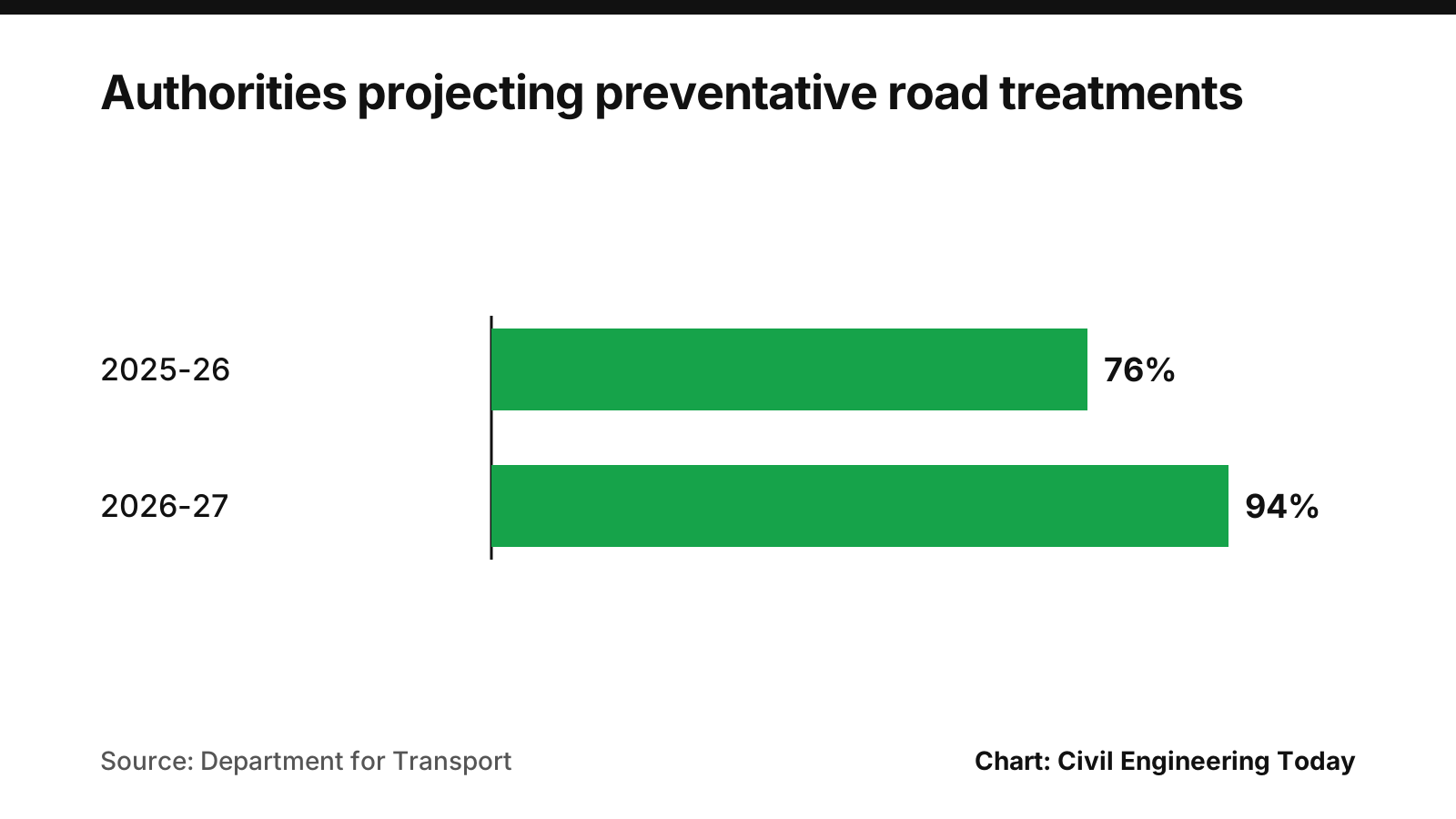
The DfT's press release said 94% of councils will complete preventative roadworks this year, against 76% last year. The department's own data table describes this as the percentage of authorities projecting to deliver preventative treatments in 2026-27, and the DfT says the transparency report data is provisional, self-reported and subject to change.
| Authorities projecting preventative treatments | Share |
|---|---|
| 2025-26 | 76% |
| 2026-27 | 94% |
The data comes from 152 of the 153 local highway authorities in England. Birmingham has not published its report and is excluded. The DfT said it will publish final disaggregated data in early 2027.
The department's transparency report summary also notes that its separate official statistics use a different definition of spending, and recorded £5.0bn of local highway maintenance expenditure in the year ending March 2025.
In 2025-26, according to the transparency reports, 77% of potholes filled by reactive repair used permanent methods, with 23% temporary. England has 184,300 miles of local roads, 97.6% of the total network.
How the incentive works
The government introduced transparency reports in 2025-26. Under the 2026-27 rules, set out in a letter to authorities from Antonia Williams, Director General of the DfT's Roads Transport Group, publishing a report unlocks 50% of an authority's incentive funding. The remaining 50% is paid subject to meeting incentive fund requirements 2, 3 and 4. Authorities had three months after the guidance to publish.
The DfT's block formula allocations for 2026-27 to 2029-30 state that in all four years at least 25% of annual incentive funding depends on publishing a transparency report, and that all incentive funding is withheld if a report is not published. The government has announced £7.3bn of capital funding for local highway maintenance over the four years, with total highways maintenance funding rising to £2,134m in 2029-30.
The first reports had to be on council websites by 30 June 2025. At that time the DfT said authorities failing to meet the conditions would have 25% of the funding uplift, £125m in total, withheld from a £1.6bn 2025-26 settlement.
Road condition statistics
The DfT said separate statistics published the previous week showed local road conditions improved in the year ending March 2026. Those statistics, which use a different measure and period from the council reports, show about 10,000km of local road was maintained in the year to March 2026, up 6.5% from about 9,400km in 2025.
The share of local A road receiving maintenance treatment rose to 5.8% in 2025 and 6.9% in 2026, after falling from 8.1% in 2014 to 4.7% in 2024. The proportion of local A roads that should have been considered for maintenance stayed at 4%, while the figure for unclassified roads fell to 16% from 17%. For B and C roads the red share rose from 5% to 7% between 2022 and 2025, then fell to 6% in 2026.
The DfT said the March 2026 release is the last in the current road condition statistics series, which will be replaced by a new standard.
Industry response
Simon Williams, RAC head of policy, said: "Getting the country's roads up to a decent standard, and keeping them there, isn't an overnight job. But at least we're now on the right track." He said surface dressing, done properly, was a cost-effective way of improving roads for the long term.
Dan Joyce, Operations Director at Kwik Fit, said the company welcomed the increased investment and the focus on proactive maintenance, according to the DfT release.
The Asphalt Industry Alliance's ALARM 2026 survey put the carriageway repair backlog in England and Wales at a record £18.62bn, which it said would take 12 years to clear. The survey, which drew responses from 79% of local authorities in England and Wales, recorded a 17% increase in average highway maintenance budgets and found almost one in six local roads, over 32,500 miles, have less than five years of structural life left.
The DfT said it will publish its final version of the 2026 transparency report data in early 2027.
On the record: Department for Transport
Sources
- Department for Transport (opens in a new tab) (accessed 2026-10-22)
- Department for Transport (opens in a new tab) (accessed 2026-10-22)
- Department for Transport (opens in a new tab) (accessed 2026-10-22)
- Department for Transport (opens in a new tab) (accessed 2026-10-22)
- Department for Transport (opens in a new tab) (accessed 2026-10-22)
- Department for Transport (opens in a new tab) (accessed 2026-10-22)
- Asphalt Industry Alliance (opens in a new tab) (accessed 2026-10-22)
This story was researched from the primary sources above and checked against them before publication. Spotted an error? Tell us and we will correct it promptly.