rail
East West Rail drops Fulbourn train care centre from DCO after industry agrees alternative
EWR Co has removed the proposed Cambridge Eastern train care centre from its Development Consent Order plans after agreeing with Network Rail and train operators to use existing rail industry-owned sites elsewhere in the Eastern region.
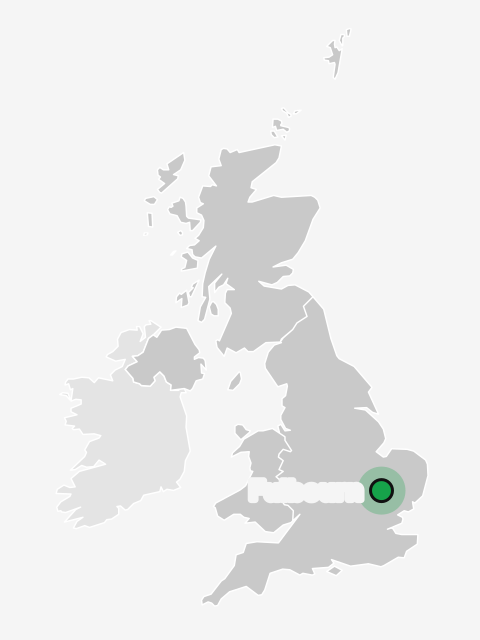
East West Railway Company has dropped its proposal for a train care centre at Fulbourn, South Cambridgeshire, after agreeing with Network Rail and train operators to use existing rail industry-owned sites elsewhere in the Eastern region instead.
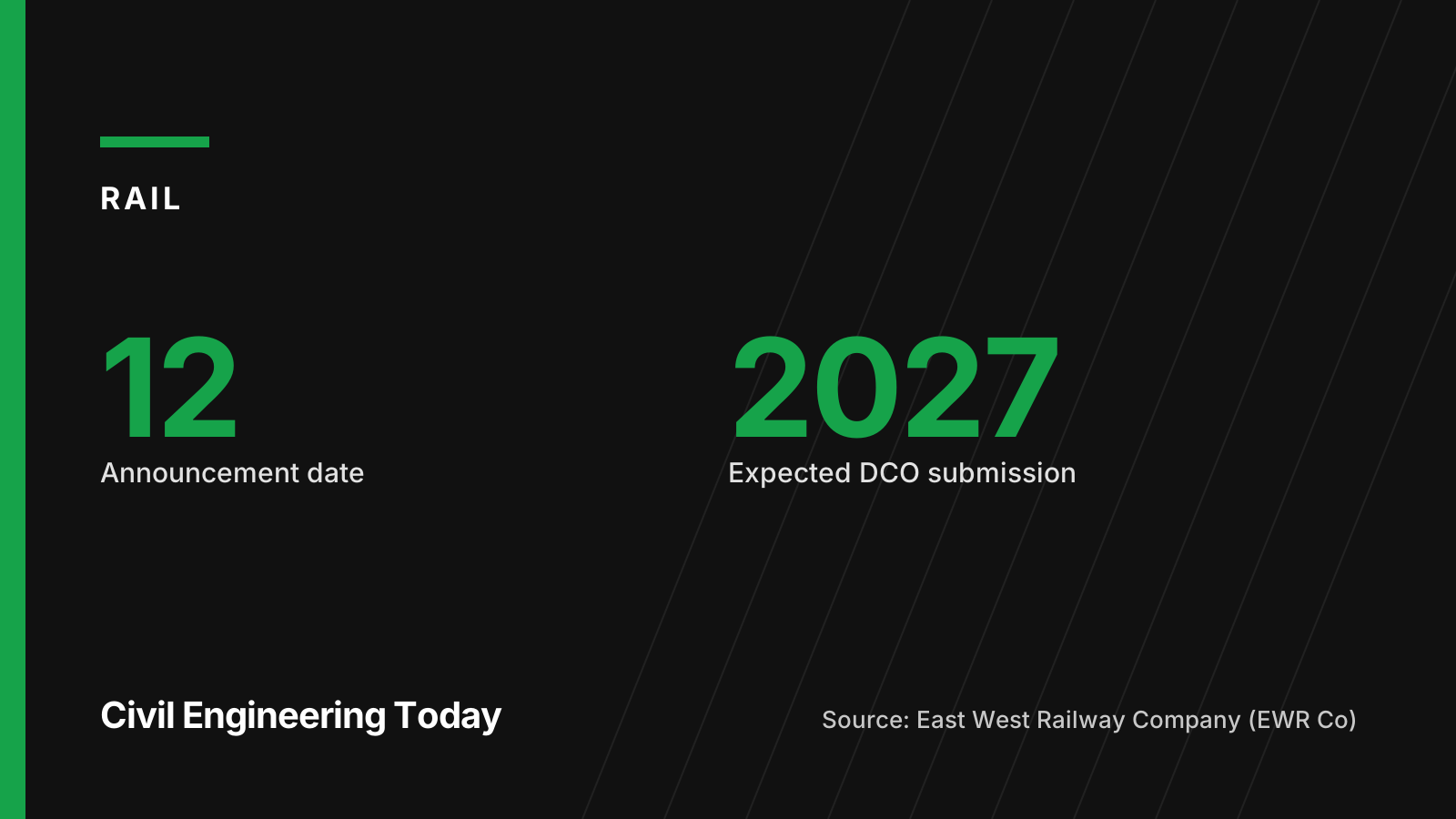
EWR Co announced on 12 October 2026 that the Cambridge Eastern train care centre (TCC) has been removed from its Development Consent Order (DCO) proposals. Train care and stabling will now be provided at a combination of existing rail industry-owned sites, none of which are in Cambridgeshire, the company said.
Fulbourn had been identified as a possible location for a facility to support the operation and maintenance of trains running on the East West Rail route and the Newmarket line.
David Hughes, chief executive of EWR Co, said: "This is a significant step forward and has only been possible because the rail industry has worked together to find a better way of meeting our requirements for a Train Care Centre."
The revised arrangement
Under the new approach, the replacement facilities will be in place before work begins at Cambridge station, EWR Co said.
Train operators that currently use stabling and train care facilities at Cambridge station will move to the additional provision during construction of East West Rail and will keep using it once the new railway is running. EWR Co will then take over use of the existing facilities at Cambridge station.
The company said the solution followed close working with Network Rail and train operators, and described it as an example of cross-industry collaboration as the sector moves towards an integrated Great British Railways.
According to EWR Co, the new approach is expected to improve service reliability by giving train operators facilities that are better located across the wider network, while maintaining train care provision during construction and for the future railway.
Background
The Fulbourn proposal was put forward earlier this year. EWR Co's 2026 consultation ran for eight weeks from 14 April to 9 June 2026. The Department for Transport (DfT) said the consultation included updated proposals on maintenance depots to support future operations.
The scheme proposes a new railway between Bedford and Cambridge, with upgrades to existing lines between Oxford and Bedford and east of Cambridge. In its consultation brochure, EWR Co said it was proposing a core service of four trains per hour across the whole route. A DfT statement issued at the launch of the consultation referred to plans for up to five trains per hour in each direction along the whole route.
The DfT said East West Rail can support up to 100,000 new homes and is expected to boost the regional economy by £6.7bn a year by 2050.
Network Rail describes East West Rail as a direct link between Oxford, Milton Keynes, Bedford and Cambridge. It says construction of Connection Stage One, from Bicester to Bletchley, was completed in 2024, and that Connection Stage Two targets an hourly Oxford to Bedford service by 2030.
What happens next
The Planning Inspectorate lists the project as East West Rail - Bedford to Cambridge and Western improvements, with East West Railway Company Limited as the applicant, at pre-application stage. The project will comprise a new railway line between Bedford station and Cambridge station.
According to the Planning Inspectorate, the DCO application is expected to be submitted in August 2027.
On the record: Department for Transport
Sources
- East West Railway Company (opens in a new tab) (accessed 2026-10-13)
- East West Railway Company (opens in a new tab) (accessed 2026-10-13)
- Planning Inspectorate (opens in a new tab) (accessed 2026-10-13)
- Department for Transport (GOV.UK) (opens in a new tab) (accessed 2026-10-13)
- Network Rail (opens in a new tab) (accessed 2026-10-13)
This story was researched from the primary sources above and checked against them before publication. Spotted an error? Tell us and we will correct it promptly.