energy
Equinor appoints ERM and CMS for Celtic Sea floating wind scoping report
The developer has named an environmental consultant and a legal adviser for the 1.5GW PDA3 site, with a scoping report required under its Round 5 lease and a Development Consent Order application to follow under the Planning Act.
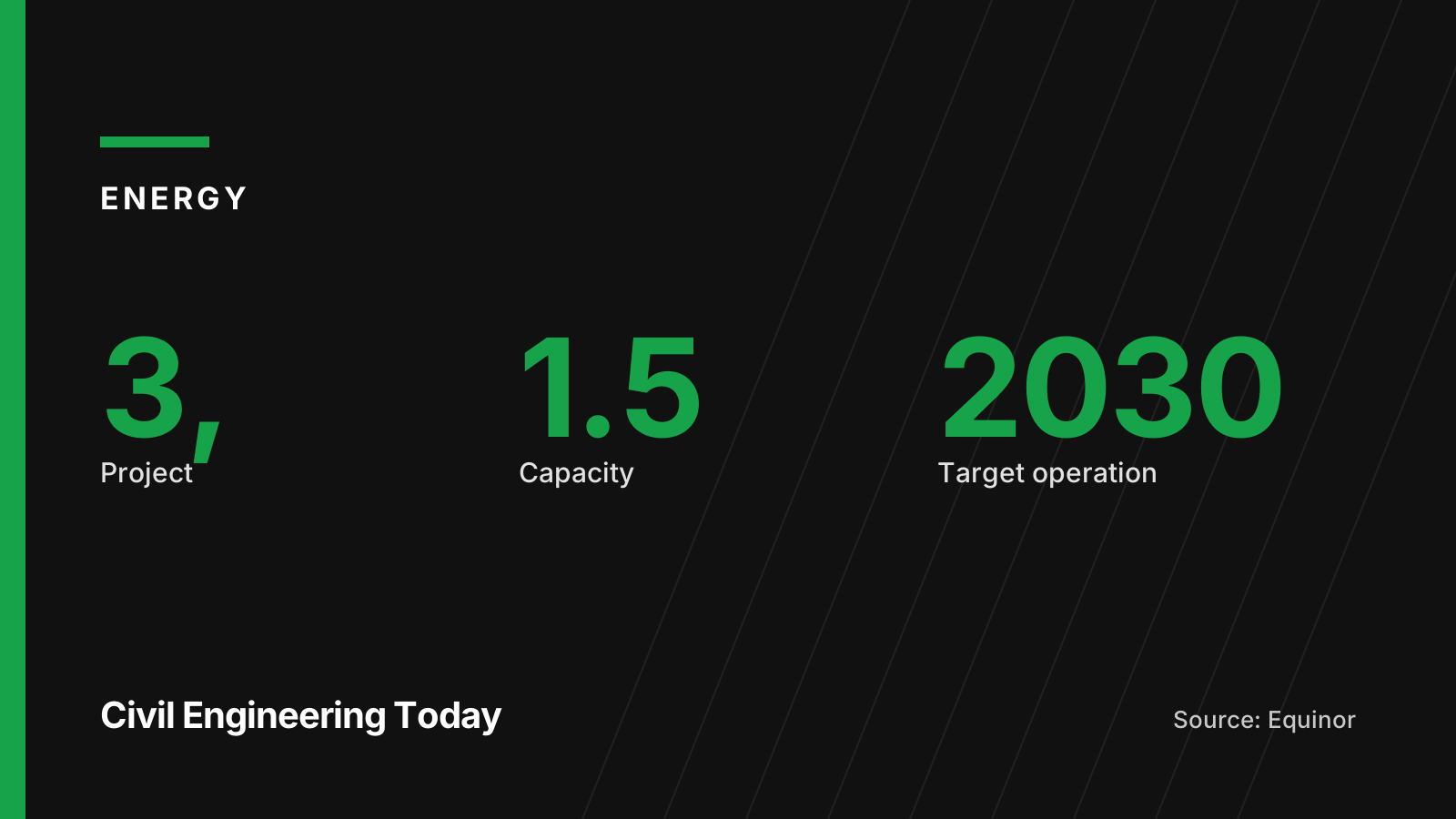
Equinor has selected ERM as environmental consultant and CMS as legal adviser to prepare the scoping report for its 1.5GW Celtic Sea floating offshore wind project, known as PDA3, the developer announced.
The scoping report is a requirement of the site's lease, Equinor said, following its award in The Crown Estate's Offshore Wind Leasing Round 5. The announcement appeared on Equinor's Celtic Sea project website on 2 October 2026 and has since been carried by Marine Energy Wales.
ERM will carry out Environmental Impact Assessment (EIA) scoping and Habitats Regulations Assessment (HRA) screening covering the wind farm itself together with its transmission cable and grid connection works, according to Equinor.
CMS will support the application for a Development Consent Order (DCO) under the Planning Act through the pre-application phase, and will advise on securing land agreements and rights.
The consenting route
Equinor said the scoping report will ask stakeholders for their views on the topics and methods proposed for the EIA. The assessment is needed for the project to be determined as a Nationally Significant Infrastructure Project through the DCO process, with further details to be published via the Planning Inspectorate.
The developer said the site has a capacity of up to 1.5GW and could be operational in the mid-2030s. Equinor's announcement describes the site as lying off the coast of South-West England; The Crown Estate, in its agreement-for-lease release, describes the Round 5 sites as lying off the coasts of South Wales and South-West England.
Equinor said work is already under way with local partners to plan social value initiatives in the region.
Background to Round 5
Equinor was granted exclusive rights to one project development area of up to 1.5GW in Round 5, which The Crown Estate announced on 19 June 2025. Equinor said Round 5 is the first floating-specific offshore wind leasing round in the UK, and that it operates nearly half of the world's floating wind generating capacity.
Under the terms Equinor set out at the time, it will pay £350 per MW per year, excluding VAT, during a 10-year option period, followed by a 60-year lease.
Trine Borum Bojsen, Senior Vice President for Renewables Europe of Equinor, said at the time of the award: "We believe that the deeper waters in the Celtic Sea have good future potential for floating wind".
The Crown Estate's June 2025 auction result also named Gwynt Glas, a joint venture between EDF Renewables UK and ESB, as preferred bidder for PDA1. PDA2 had no preferred bidder at that stage and was to be taken forward through separate delivery arrangements.
Equinor and Gwynt Glas have since both entered into agreements for lease with The Crown Estate. Under those agreements, The Crown Estate said, the developers are expected to focus on project design, surveys, EIAs, public engagement and planning consents before applying for a full lease. The developers have committed that at least 3.5% of all new workers involved in developing the projects will be apprentices.
Melissa Read, Head of Regional Development UK Renewables at Equinor, said of that stage: "Completion of the Agreement for Lease is a positive step forwards since the Round 5 Auction in June."
On 3 March 2026, The Crown Estate announced that Ocean Winds, the 50-50 joint venture between EDPR and ENGIE, had entered an agreement for lease for the third Round 5 site, completing the line-up of three developers in the Celtic Sea.
Scale of the programme
The Crown Estate's Round 5 page says the round could create up to 4.5GW of new renewable energy capacity across about 1,000km2 of seabed split between three project development areas. It expects about 5,300 permanent jobs during the construction phase and estimates £300m of annual economic activity in the UK while construction is under way.
The Crown Estate's June 2025 release cited research showing Round 5 could support 5,300 new jobs and a £1.4bn boost to the UK economy; its later agreement-for-lease releases put the figure at more than 5,000 new jobs.
The Crown Estate also said the UK Government has confirmed its intention to unlock space for a further 12GW of capacity in the Celtic Sea beyond Round 5.
Equinor said details of the scoping stage will be made available through the Planning Inspectorate.
Sources
- Marine Energy Wales (opens in a new tab) (accessed 2026-10-18)
- Equinor (opens in a new tab) (accessed 2026-10-18)
- Equinor (opens in a new tab) (accessed 2026-10-18)
- The Crown Estate (opens in a new tab) (accessed 2026-10-18)
- The Crown Estate (opens in a new tab) (accessed 2026-10-18)
- The Crown Estate (opens in a new tab) (accessed 2026-10-18)
- The Crown Estate (opens in a new tab) (accessed 2026-10-18)
This story was researched from the primary sources above and checked against them before publication. Spotted an error? Tell us and we will correct it promptly.