rail
Government accepts 15 of CMA's 19 road and rail procurement recommendations, CECA urges pace
Civils contractors have welcomed the Government's response to the Competition and Markets Authority's civil engineering market study but want ministers to move quickly, particularly on a promised decision over Z clauses.
The Civil Engineering Contractors Association (CECA) has welcomed the Government's response to the Competition and Markets Authority's civil engineering market study, published on 24 November 2026, while urging ministers to implement the reforms at pace.
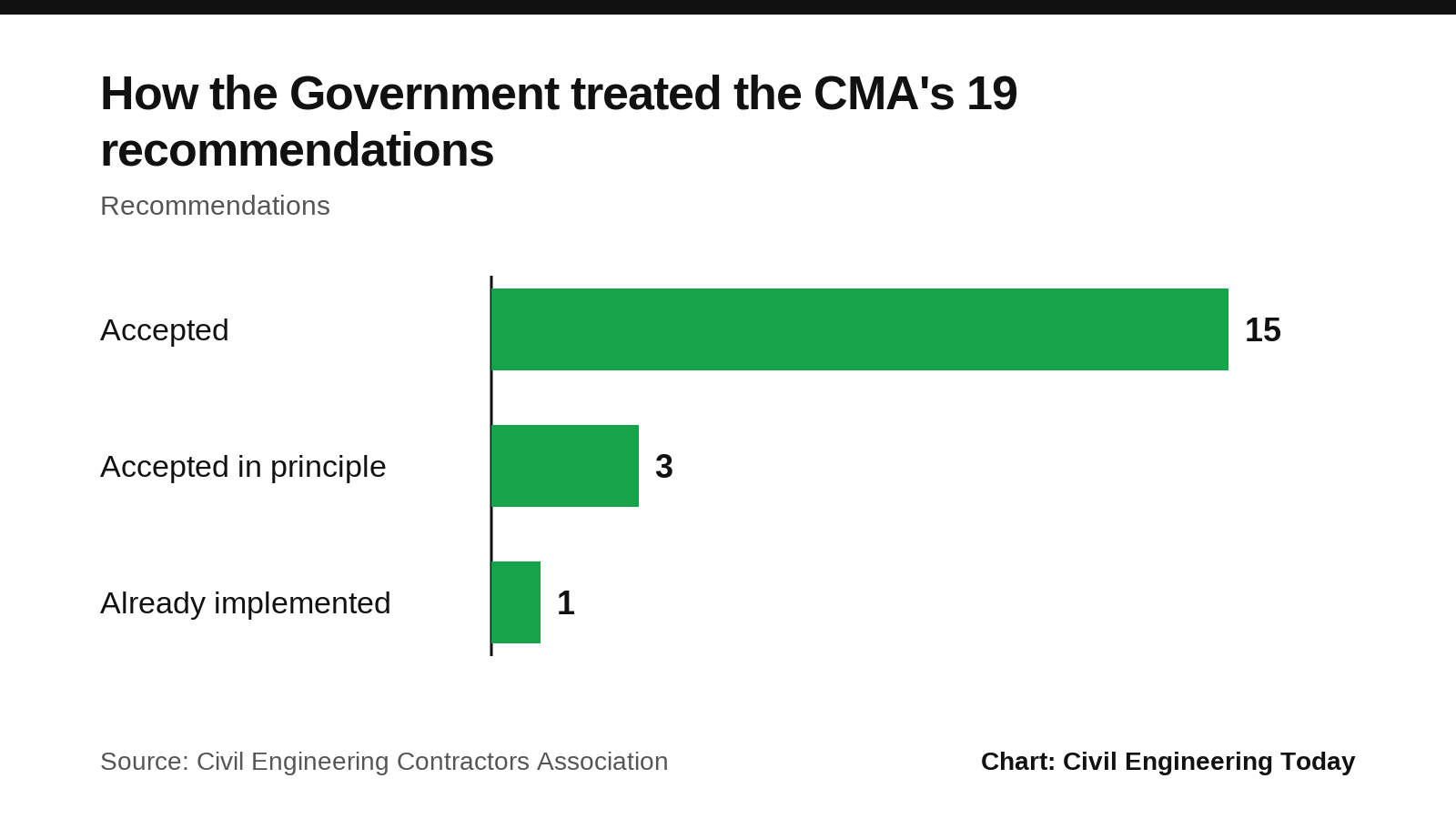
According to CECA, the Government accepted 15 of the Competition and Markets Authority's (CMA) 19 recommendations, accepted a further three in principle and treated one as already implemented at UK Government level. The response published on GOV.UK confirms the 15 accepted and three accepted in principle.
CECA said the key commitments were a strategic sector plan for road and rail civil engineering, greater flexibility for procuring authorities to enter longer-term contracts, improvements to the UK Infrastructure Pipeline and stronger compliance with the Construction Playbook.
Ben Goodwin, CECA Director of Policy & Public Affairs, said: "We are extremely pleased that the Government has accepted the vast majority of the CMA's recommendations and believe their implementation has the potential to deliver substantial benefits in terms of the cost, efficiency and productivity of infrastructure delivery in the UK."
How the recommendations were treated
| Government position | Recommendations |
|---|---|
| Accepted | 15 |
| Accepted in principle | 3 |
| Already implemented at UK Government level | 1 |
Source: CECA
Z clauses
CECA's main reservation concerns contractual risk allocation. Goodwin said the recommendation on risk allocation and the use of Z clauses, which amend standard forms of contract, was among those the Government accepted only in principle.
"The inappropriate use of Z clauses to amend standard forms of contract can undermine the principles of collaborative working, equitable risk sharing and streamlined project management across the infrastructure sector," he said.
According to CECA, the Government has committed to set out by spring 2027 whether the Department for Transport intends to review Z clauses and what any such review would cover. Goodwin urged ministers to move at pace on the issue for the benefit of contractors, infrastructure clients and the taxpayer.
CECA said the priority now was to turn the commitments into improved market conditions for businesses across the infrastructure supply chain.
The CMA study
The CMA's market study covered the design, planning and delivery of railway and public road infrastructure by the UK civil engineering sector. The study began in June 2025, and the CMA published an interim report on 17 December 2025 that identified uncertain and short-term funding, and regulatory barriers to entry and growth, among its concerns. CECA responded to the interim report consultation in January 2026.
The CMA published its final report on 21 May 2026. It said about £19bn of taxpayers' money was spent on public road and railway infrastructure in 2023/24, excluding High Speed 2, and cited external research suggesting the UK and devolved governments could save up to £5bn a year.
Sarah Cardell, Chief Executive of the CMA, said at the time that a short-term and fragmented approach to procurement in road and rail was driving up costs.
The CMA recommended that HM Treasury take strategic ownership of system-wide change in the road and rail civil engineering market, and that the UK Government publish a strategic sector plan for the sector and report annually on progress. In May 2026 Goodwin backed the CMA's call for the UK and devolved governments to set a strategic direction for infrastructure.
The Government response, published jointly by the Department for Business, Innovation, Science and Trade, the Department for Transport, the National Infrastructure and Service Transformation Authority, the Ministry of Housing, Communities and Local Government and the Government Commercial Function, records that the CMA found significant opportunities to improve outcomes in the market.
CECA has more than 300 member companies across six English regions, Scotland and Wales, and says its members carry out an estimated 70 to 80 per cent of all civil engineering activity in the UK.
The next fixed point is spring 2027, when the Government has said it will set out whether the Department for Transport will review Z clauses.
On the record: Department for Transport, Ministry of Housing, Communities and Local Government
Sources
- Civil Engineering Contractors Association (opens in a new tab) (accessed 2026-11-25)
- GOV.UK (Department for Business, Innovation, Science and Trade; Department for Transport; National Infrastructure and Service Transformation Authority; Ministry of Housing, Communities and Local Government; Government Commercial Function) (opens in a new tab) (accessed 2026-11-25)
- Competition and Markets Authority via GOV.UK (opens in a new tab) (accessed 2026-11-25)
- Competition and Markets Authority via GOV.UK (opens in a new tab) (accessed 2026-11-25)
- Competition and Markets Authority via GOV.UK (opens in a new tab) (accessed 2026-11-25)
- Civil Engineering Contractors Association (opens in a new tab) (accessed 2026-11-25)
- Civil Engineering Contractors Association (opens in a new tab) (accessed 2026-11-25)
- Civil Engineering Contractors Association (opens in a new tab) (accessed 2026-11-25)
This story was researched from the primary sources above and checked against them before publication. Spotted an error? Tell us and we will correct it promptly.