energy
Skanska completes precast aseismic bearing pedestal demonstrator for Rolls-Royce SMR in Doncaster
The contractor has built and trialled a first-of-its-kind precast pedestal at its Bentley Works facility under a contract awarded by Rolls-Royce SMR, as the Wylfa programme moves towards delivery.
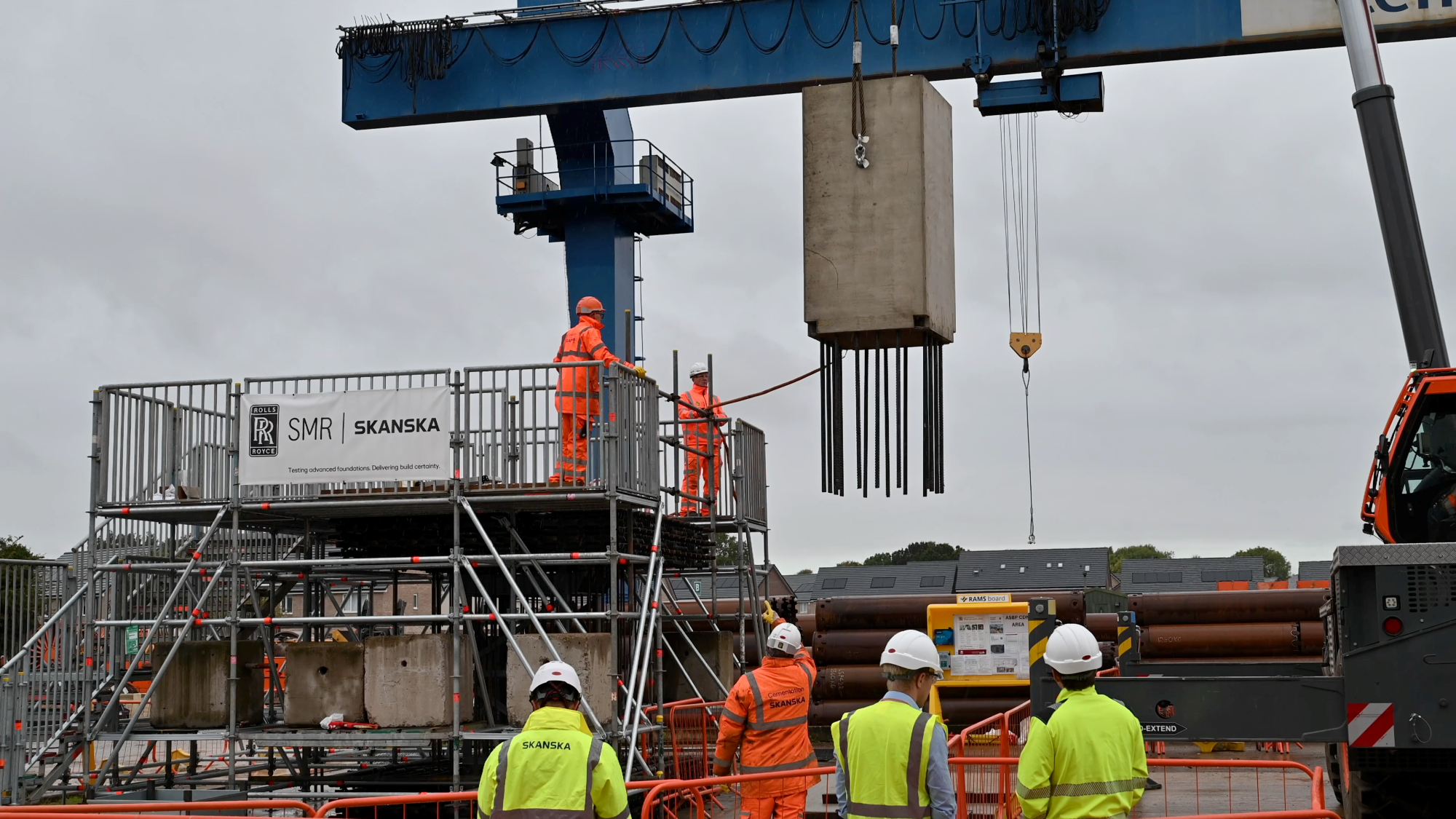
Skanska has completed an aseismic bearing pedestal demonstrator for Rolls-Royce SMR at its Bentley Works facility in Doncaster, proving that the precast component can be produced off site for the company's factory-built nuclear power plant.
The contractor said the demonstrator, built and trialled at the Cementation Skanska site, had shown how the first-of-its-kind pedestal could be made in a controlled factory environment rather than at the final construction site.
Aseismic bearing pedestals support the structural isolation devices that decouple buildings and infrastructure from ground movement during an earthquake, Skanska said. It described them as a critical part of the Rolls-Royce SMR design.
Ruth Todd, Operations and Supply Chain Director, Rolls-Royce SMR, said: "Our delivery programme is ramping up. By testing and refining critical components ahead of deployment, we can reduce risk, improve predictability and strengthen confidence in our fleet delivery model."
The contract
Rolls-Royce SMR awarded Skanska UK the demonstrator contract in an earlier announcement. At the time Skanska said the work would be delivered from its fabrications facility in Doncaster, with the prototype developed and technical trials run over the coming months.
The aseismic bearing system was described at award as allowing the Rolls-Royce SMR design to be standardised across a range of geotechnical and seismic conditions. Adam McDonald, Executive Vice President at Skanska UK, said then that the company would bring its civil engineering, design and fabrications expertise to build and test the pedestal.
The completed programme brought together Skanska's civil engineering and design capabilities with manufacturing and trials at Cementation Skanska, the group's specialist trading arm for piling, ground engineering and steel fabrications, which traces its roots to foundation work in 1910.
Terry Muckian, Executive Vice President, Skanska UK, said: "Successfully completing this demonstrator is an important achievement for both teams. It shows the value of collaboration in testing and proving the construction approach before moving into delivery."
Skanska said manufacturing elements away from the construction site had the potential to give greater control over production, quality and sequencing, and to make construction more predictable. The demonstrator forms part of Rolls-Royce SMR's approach of testing and proving construction methods before they are used on future plants, the company said.
Why the component matters
The Office for Nuclear Regulation (ONR) says seismic isolation has never been used on a nuclear power plant in the UK and that its use on nuclear installations is considered innovative. It describes the Rolls-Royce SMR as the first reactor design to propose seismic isolation in the UK.
According to ONR, aseismic bearings limit the effects of earthquakes on the reactor and allow standard designs to be used without detailed re-analysis of each site. The regulator commissioned independent research in 2023 into applying seismic isolation to small modular reactors (SMRs) and advanced modular reactors in the UK.
The Wylfa programme
The demonstrator sits within a UK deployment programme that has firmed up since the contract was let. At contract award Skanska described Rolls-Royce SMR as preferred bidder in the Great British Energy - Nuclear (GBE-N) competition; GBE-N had selected it as preferred technology partner in June 2025, and the two signed a contract in April 2026 to design and build the SMRs at Wylfa.
The government confirmed Wylfa on Anglesey as the site for the UK's first SMR power station on 13 November 2025. Skanska's release refers to the site as Gwyndod, Anglesey, North Wales.
According to GBE-N, the programme will deliver three reactors and at least 1.4GW of power. The government said in November 2025 that the first SMR programme is backed by over £2.5bn of funding, that the project is expected to support up to 3,000 jobs locally at peak construction, and that GBE-N assesses the site could host up to eight units.
GBE-N said it has awarded nearly £900m in contracts since 2023, with over 70% going to UK-registered companies, against an ambition of 70% British-built content across the SMR fleet. Rolls-Royce SMR has spent over £300m through its supply chain since its launch in 2021, GBE-N said.
Beyond the UK, Rolls-Royce SMR has been selected by Czech utility ČEZ to build up to three gigawatts of new nuclear capacity in the Czech Republic and, in June 2026, by Swedish development company Videberg Kraft to build SMRs in Sweden.
The government's ambition is for Wylfa's reactors to be supplying power to the grid from the mid-2030s, with Skanska saying the Czech Republic and Sweden are expected to follow.
Sources
- Skanska UK (opens in a new tab) (accessed 2026-11-19)
- Skanska UK (opens in a new tab) (accessed 2026-11-19)
- UK Government (GOV.UK) (opens in a new tab) (accessed 2026-11-19)
- Great British Energy - Nuclear (GOV.UK) (opens in a new tab) (accessed 2026-11-19)
- UK Government (GOV.UK) (opens in a new tab) (accessed 2026-11-19)
- Office for Nuclear Regulation (opens in a new tab) (accessed 2026-11-19)
- Skanska UK (opens in a new tab) (accessed 2026-11-19)
This story was researched from the primary sources above and checked against them before publication. Spotted an error? Tell us and we will correct it promptly.