policy
ACE welcomes government response to CMA road and rail study but says reforms are a year away
The consultancy trade body said ministers had understood what was at stake in accepting the CMA's civil engineering recommendations, but argued the biggest procurement changes would not start until 2027.
The Association for Consultancy and Engineering (ACE) has welcomed the government's response to the Competition and Markets Authority's civil engineering market study, published on 24 November, but warned that the biggest reforms are a year from starting.
ACE said the response made the Construction Playbook mandatory for national authorities and committed the Department for Transport (DfT) to a road and rail sector plan by winter 2027.
But the trade body said too many of the most important reforms remained a decision about whether to act rather than a commitment to act. Most commitments, it said, run through a cycle of mapping, options and pilots across 2027, with real changes to how projects are procured and designed unlikely before 2028-29.
Milda Manomaityte, chief executive of ACE, said: "This is genuinely good news. By accepting all 19 of the CMA's recommendations, ministers have shown they understand what's at stake."
ACE said it was asking the government to bring its reviews forward and set firm dates for standardising procurement. Manomaityte also said that giving designers a stronger, properly funded early role must be at the heart of the sector plan.
How many recommendations were accepted
Trade bodies and the government describe the response differently. ACE said the government had accepted all 19 of the CMA's recommendations.
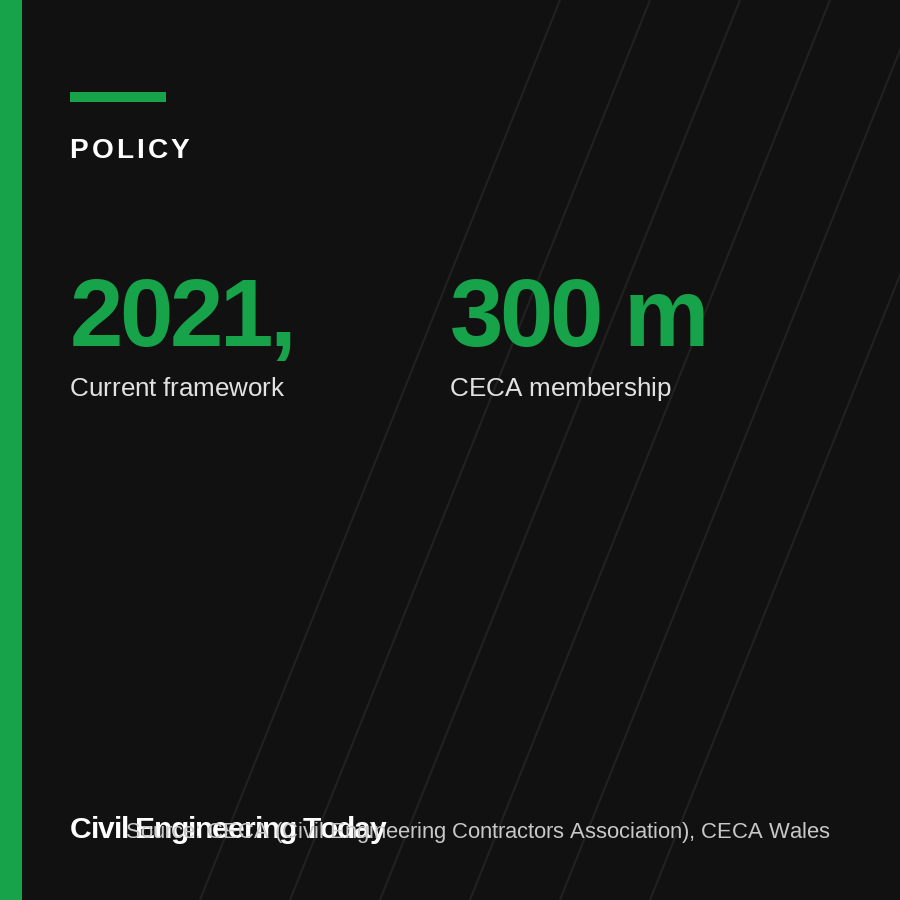
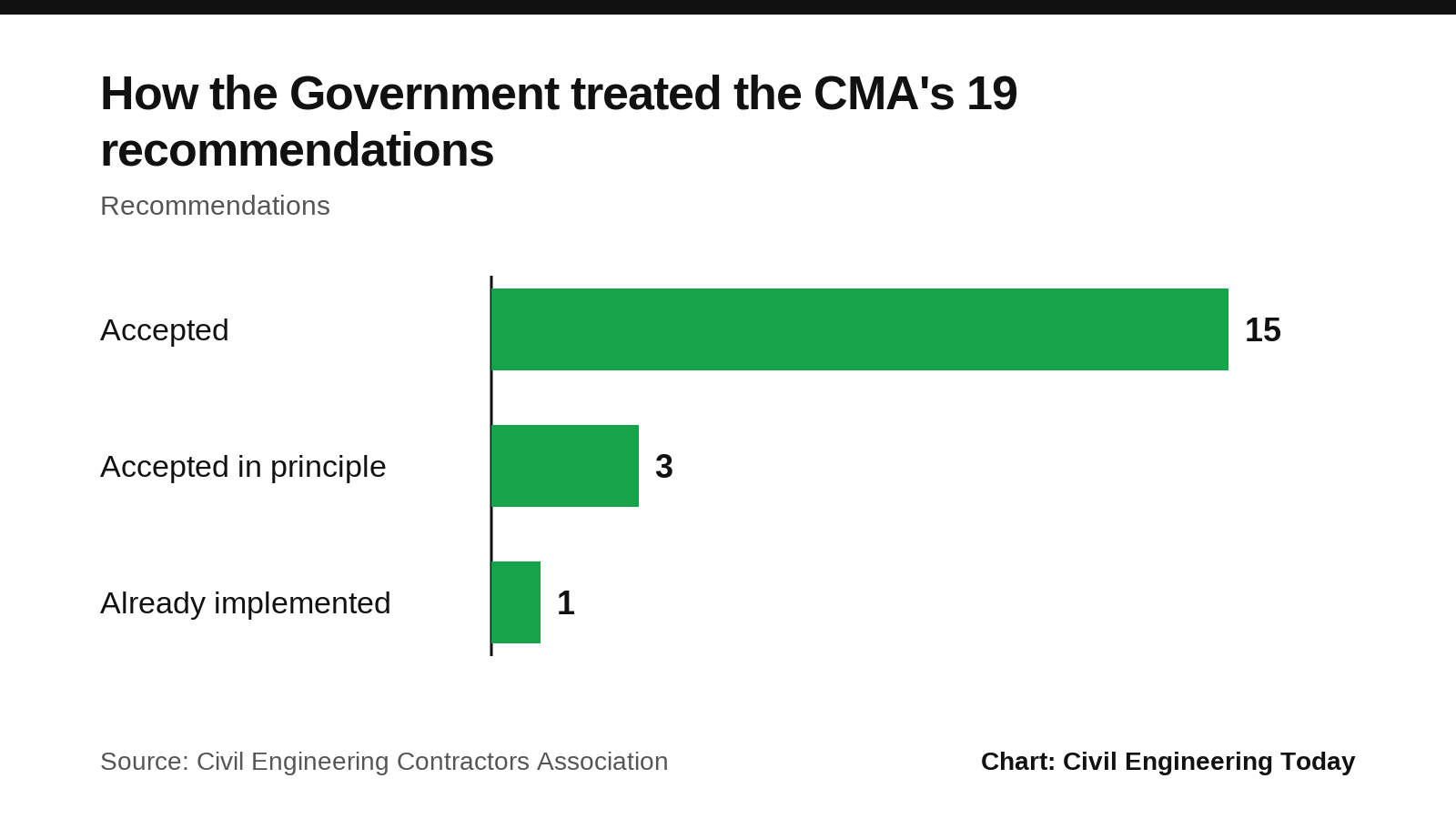
The Civil Engineering Contractors Association (CECA) said the government had accepted 15 of the 19, with a further three accepted in principle. The GOV.UK publication page for the response says the government accepts 15 recommendations, with three accepted in principle and one already implemented at UK government level.
The two bodies also describe the Construction Playbook commitment in different terms. ACE said the response makes the Playbook mandatory for national authorities; CECA described it as strengthened compliance with the Playbook.
The response was published jointly by the Department for Business, Innovation, Science and Trade, the DfT, the National Infrastructure and Service Transformation Authority, the Ministry of Housing, Communities and Local Government and the Government Commercial Function.
CECA's position
CECA said key commitments in the response included greater flexibility for procuring authorities to enter longer-term contracts, strengthened compliance with the Construction Playbook and improvements to the UK Infrastructure Pipeline.
The contractors' body also highlighted a separate timetable point: the government has committed to setting out by spring 2027 whether the DfT will review Z clauses, the bespoke amendments made to standard contract forms.
Ben Goodwin, CECA director of policy and public affairs, said: "We would urge the Government to move at pace on this issue."
The CMA study
The CMA published its final report on 21 May 2026, addressing its recommendations to the UK, Scottish and Welsh governments and the Northern Ireland Executive. At that point the UK government had committed to responding to CMA recommendations within 90 days; the response appeared on 24 November.
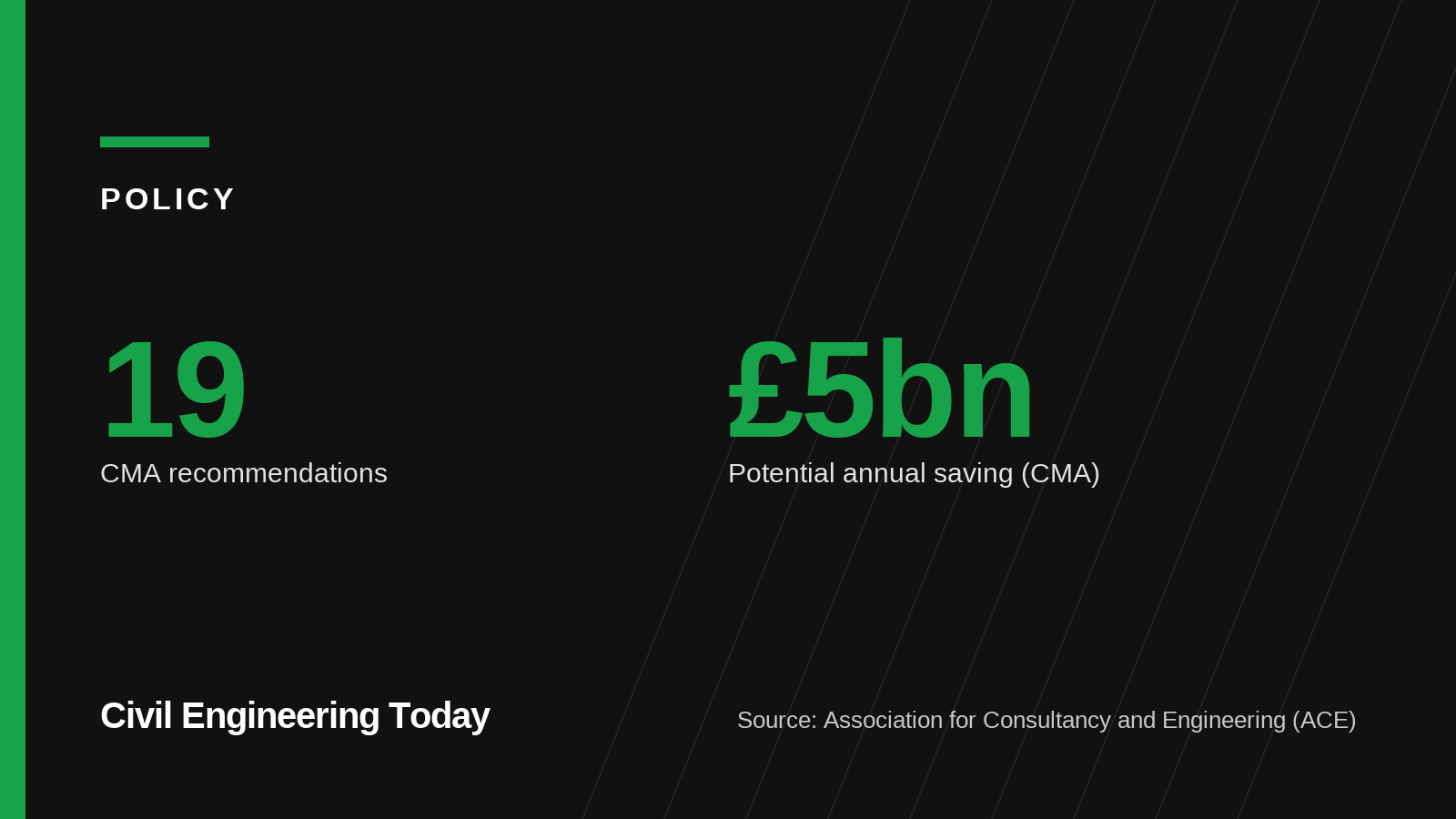
The regulator said about £19bn of public money was spent on public road and railway infrastructure in 2023/24, excluding HS2, and that external research highlighted in its report suggested governments could potentially save up to £5bn a year. ACE set that figure against the government's planned £725bn of infrastructure investment over the next decade.
Sarah Cardell, chief executive of the CMA, said at the time that a short-term and fragmented approach to procurement in road and rail was driving up costs. Among the CMA's recommendations was that governments publish a strategic sector plan for civil engineering in the road and rail sector.
When the CMA launched the study, it said road and railway projects accounted for around 70-75% of government spending on economic infrastructure and that the civil engineering sector added £23bn to the UK economy in 2023. It cited the National Infrastructure Commission's finding that system-wide improvements could save 10-25% across infrastructure projects.
The study covered the full life cycle of roads and railways, including enhancement and maintenance, but excluded HS2, privately procured roads and small maintenance such as potholes.
The government has said it will set out by spring 2027 whether the DfT will review Z clauses, with the road and rail sector plan due by winter 2027.
On the record: Department for Transport, Ministry of Housing, Communities and Local Government
Sources
- Association for Consultancy and Engineering (opens in a new tab) (accessed 2026-11-25)
- GOV.UK (Department for Business, Innovation, Science and Trade; Department for Transport; NISTA; MHCLG; Government Commercial Function) (opens in a new tab) (accessed 2026-11-25)
- Civil Engineering Contractors Association (opens in a new tab) (accessed 2026-11-25)
- Competition and Markets Authority (GOV.UK) (opens in a new tab) (accessed 2026-11-25)
- Competition and Markets Authority (GOV.UK) (opens in a new tab) (accessed 2026-11-25)
- Competition and Markets Authority (GOV.UK) (opens in a new tab) (accessed 2026-11-25)
This story was researched from the primary sources above and checked against them before publication. Spotted an error? Tell us and we will correct it promptly.